

Shipping calculated at checkout
Couldn't load pickup availability
Questions about this product? Ask our scientists!
Minute™ Nuclear Proteasome Enrichment Kit (20 preps)
SKU:Cat #: PN-041
 Powered by Bioz
Manual & Protocol | MSDS
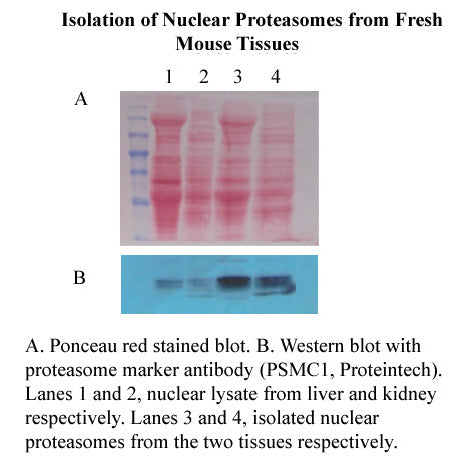
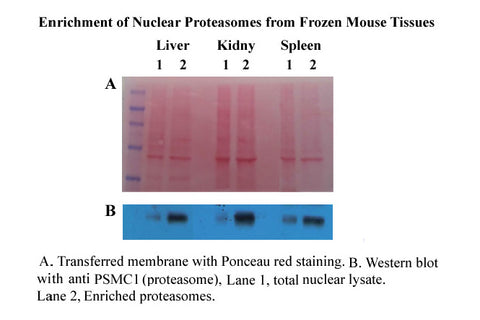
The proteasome is a protein degradation system that requires metabolic energy and ubiquitin polymerization, unlike lysosome-based protein degradation. The 26S proteasome is made up of two subcomplexes (a 20S proteasome and one or two19S regulatory particles). Proteasomes are mainly localized in the cytosol but are also detected in the nucleus. Traditionally, ultracentrifugation and affinity isolation are the most common methods for isolating proteasomes. These methods, though relatively effective, are usually time-consuming and yield low amounts. Many affinity-based methods require harsh elution conditions that may affect isolated proteasome activity and limit certain downstream applications. In most cases, the methods can’t distinguish proteasomes derived from the cytosol or nucleus. To overcome these shortcomings, we have developed spin-column-based kits for the enrichment of proteasomes from nuclei (Cytosolic Proteasome Enrichment Kit is also available under Cat # PT-040). The protocol is simple, rapid, and high-yielding. The gentle protocol maintains proteasome association with ubiquitin and other proteins and is useful for studying proteasome structure and function. The highly enriched proteasomes can also be used as a starting material for affinity purifications.
Kit Components:
|
Items |
Quantity |
|
Buffer A |
30 ml |
|
Buffer B |
8 ml |
|
Filter Cartridges with collection tube |
40 units |
|
Pestle for 1.5 ml tube |
2 units |
|
Protein extraction powder |
2.0 grams |
References (1)
1. Zhang, C. Y., Zhang, R., Zhang, L., Wang, Z. M., Sun, H. Z., Cui, Z. G., & Zheng, H. C. (2023). Regenerating gene 4 promotes chemoresistance of colorectal cancer by affecting lipid droplet synthesis and assembly. World Journal of Gastroenterology, 29(35), 5104-5124.